Clutter or Hoarding? 7 Signs It's Time for Outside Help
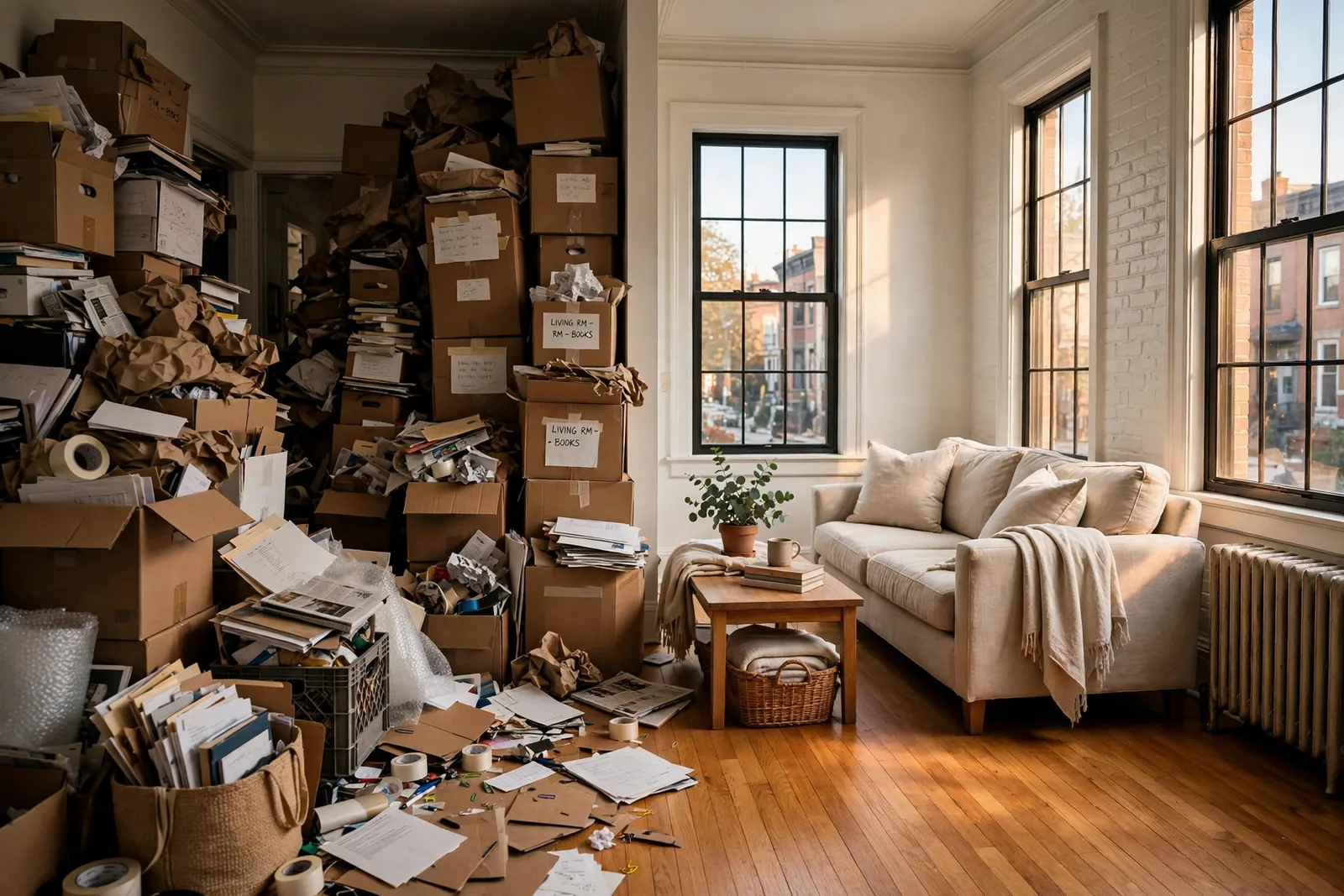
Everyone has a junk drawer — or a spare room, a garage, or a closet full of things you meant to sort out. Sometimes it's just life. Sometimes it's clutter or hoarding, and it can be hard to tell the difference from the inside.
This guide helps you tell the difference — kindly, and without judgment — so you can figure out what kind of help to ask for, and when.
Clutter or Hoarding? How to Tell the Difference
Clutter is part of a busy life. It can be stressful and messy, but it doesn't usually take over a home, or stop you from using it. Hoarding is different: it's when things pile up in a way that takes over rooms, blocks access, and makes the home unsafe. It's not a choice, and it's not a character flaw — it's a condition that makes it hard to let things go, and it changes how a home works.
The key difference is function: if the home no longer works the way a home should — if you can't cook in the kitchen, sleep in the bedroom, or get through the hallway safely — then you're not just dealing with clutter.
Clutter or Hoarding? 7 Signs It's Time for Outside Help
1. Rooms can't be used for their purpose
The bedroom is full of boxes. The bathroom sink is covered in products. You sleep in a chair. The tub holds boxes. The kitchen counter is covered, so you eat at the table. When rooms stop working for what they're meant for, you're not just behind on cleaning.
2. Animals and insects are moving in
Bugs, mice or other pests appear when food or debris builds up, especially in kitchens and near pet areas. It's not just a pest problem — it's a sign the home has too much material for one household to manage.
3. Utilities are blocked or not maintained
The furnace is buried behind boxes. The water shutoff is hidden. A broken pipe or blocked drain has gone unrepaired for months. When you can't reach or maintain basic systems, the home becomes harder to live in — and riskier.
4. There are huge piles by the door
Piles by the front and back doors, or in front of a shed, often mean someone no longer knows where to put things. Every bag or box becomes another obstacle, and moving around the house gets harder.
5. Food is rotting away somewhere
Old food on counters, in cupboards, or in the fridge is a common sign that things are piling up. It is easy to forget what's there when there is too much to look through.
6. Dangerous items are in the way
Piles of newspapers near a heater. Heavy items on stairs. A gas canister near the boiler. A broken chair blocking a hallway. When clutter becomes a risk, it stops being an inconvenience.
7. It's been going on for years
Clutter is often temporary. Hoarding is often long-term: over 5 years, and getting worse. A long-standing pattern is one of the clearest signs that outside help would make more progress than another clean-up attempt alone.
What To Do About Clutter or Hoarding
If the signs sound like clutter: start small. Pick one drawer, one shelf, or one corner. Put items into three groups: Keep, Donate, or Bin. Work for 15 minutes at a time, and ask a friend or family member to sit with you. There's no shame in just wanting a cleaner, simpler home.
If the signs sound like hoarding: you're not alone, and it's not a choice. Getting help doesn't mean losing your home — it means getting a place that works again.
Start by talking to a family member or a professional. If you're worried about a loved one, read our guide on Hoarding Help for Baltimore Families. If you're thinking about raising it with someone, see How to Talk to Someone Who Hoards. And if cost worries you, see How Much Does Hoarding Cleanup Cost in Baltimore? — whole-house cleanout bundles start from around $700, junk removal from $125, and deep cleaning from $200.
Learn more about our hoarding cleanup service.
Clutter or Hoarding? Frequently Asked Questions
How do I tell if it's clutter or hoarding?
If the home still works — you can cook, sleep, use the bathroom, and get in and out safely — it's probably clutter. If rooms have stopped working, or if there are safety or hygiene problems, it may be hoarding.
Can I start with just one room?
Yes. Start small: one room, or even one corner. If that's hard too, outside help makes a real difference. We can work at a pace that feels manageable, without pressure or judgment.
Getting Help — Without Pressure or Judgment
Reach out when you're ready. Text us photos of the space and we'll walk you through what help looks like, and what it'll cost. No obligation, no judgment. Call (410) 870-9347 and talk to someone who gets it — one call at a time.
This article is general information and isn't a diagnosis. A licensed mental health professional can assess hoarding disorder.
Related reading
 Hoarding HelpHoarding Help in Baltimore, MD: Where Families Can StartIf someone you love is living in a home that's becoming unsafe, help is closer — and more judgment-free — than you think. HCOB Property Services provides hoarding help across Baltimore, Maryland.Read 3 min →
 Hoarding HelpHow Much Does Hoarding Cleanup Cost in Baltimore?Straight answer on hoarding cleanup cost in Baltimore, what moves the number, and how to get a private price from photos.Read 2 min →
 DeclutteringWhere to Donate Furniture and Household Items in BaltimoreClearing out a home doesn't mean everything goes to the dump. Here's where to donate furniture and household items in Baltimore, and what to do with the rest.Read 4 min →